Showing posts with label news. Show all posts

21 August 2008

Unweary

Starting today I'll be writing at a new blog location: http://unweary.com/blog/ I've redirected the old RSS feed http://feeds.feedburner.com/davidweiss to the new blog. If you want to subscribe to the shiny new RSS feed http://feeds.feedburner.com/unweary please go right ahead. At some point I'll take down the old RSS feed. This change includes an upgrade from Blogger to Movable Type as my blogging platform, but if you sensed that there was more to the blog location change than just that, you were right. I'm "going indie", as they say. :-) This is something I've wanted to do for a long time and now is the time to make it official. I quit working for the MacBU at Microsoft in December 2007 to go back to school. I'm very much enjoying school, and I'm trying hard to keep that my main focus, but I keep wanting to build stuff and publish it and Unweary is just a natural result of that innate desire to create. I expect to build pretty focused, humble, non-life changing software that just makes regular things easier and better in some way. Right now I'm mostly trying to decide which idea to tackle first. I feel like a kid in a candy shop! So that's the news. I'm sure I'll write more about the adventure as it develops, but in the meantime, wish me luck!

28 January 2008

Passing of President Gordon B. Hinckley

Beloved Church President Gordon B. Hinckley, who led The Church of Jesus Christ of Latter-day Saints through 12 years of global expansion, has died at the age of 97. President Hinckley was the 15th President in the 177-year history of the Church and had served as its President since March 12, 1995.

I suppose he said it best:

Death is a part of life. It is a fundamental, basic part of our eternal lives. We can't go on with the great work that lies ahead without stepping over the threshold of death, sorrowful as it is for those who remain. I am satisfied that it is a beautiful experience for those who make that step, who have lived lives of righteousness and faithfulness. - Gordon B. Hinckley, Ensign, Aug 1997, 3

For my part, this man was an example to me of someone who finished the course, kept the faith. (2 Timothy 4:7) I will miss him.

01 January 2008

Leaving Microsoft

Starting today I no longer work at Microsoft. As many of you know, I started working at Microsoft after an illustrious post high school career as landscape architect. ;-) I loved the landscape work, but Microsoft paid better. I was just barely 18 and Microsoft was just realizing that the internet (lower case then) was amazingly NOT going to be replaced by the Windows 95 Microsoft Network. Much has changed since then. While I started my 4 year degree and continued working on it part time, it’s now time for me to go back to school full time and finish. After that, I hope to get an MBA.

I’ve had a remarkable time at Microsoft and in MacBU in particular. I’ve learned so much. I’ve been so thankful to interact with such a high concentration of good individuals. I feel very blessed. My last day was December 31st, 2007.

So that’s the news. I realize that many of you subscribe to this blog because of my connection with Microsoft and especially MacBU. Since I'm no longer working there, feel free to unsubscribe. During the Holiday's I've been mentally processing my MacBU experience and I'll be posting much of what I have learned and observed. If that interests you, hang on, there might still be some content here for you! As you may have noticed I've not really posted anything since September when I returned to work after paternity leave! These last 3 months finishing up Office 2008 were quite the grind, not a death march, but certainly not pretty. I'm glad for it to end. With a bit more time, I think you'll see some more frequent posts here.

If you'd like to contact me informally, as always, feel free to email me at my Gmail account referenced on my Blogger profile page. If you'd like to contact/track me more professionally, feel free to follow my LinkedIn profile.

Happy New Year to all and wish me luck!

15 August 2007

Numbers

One of the great benefits of working at Microsoft is that when you add a new little one to your family, you get 1 month of paid paternity leave. Recently, we've had the opportunity to take advantage of this benefit. Since our little baby was born, I've been home working as Mr. Mom. I've been mostly offline, except for early mornings and late nights when the kids are sleeping. My boss isn't going to like it, but since I've been gone for paternity leave, I've logged on to my work email only once, and that was just to make sure my out of office emails were working. Needless to say, I've been happily busy with family.

I haven't been so busy that I didn't catch Apple's announcement regarding their new iWork application, Numbers. I haven't bought a copy, or logged into work to see what others are saying about this announcement, but I'm guessing it's much like when Apple announced Keynote for the first time. A combination of deep respect for Apple's software and design capabilities, coupled with sense of, "Let's get back to work and make something great!" kind of attitude.

What follows are some of my personal feelings that I've considered amidst making meals and playing at the park with my kids. I don't in any way attempt to speak for MacBU or Microsoft, these are just one person's opinions, specifically mine. And yes, I do work in MacBU, and yes I can't share everything I'd like to say for obvious reasons. So, here goes:

Once upon a time, it was decided that we needed to move to a more open file format. XML was the obvious choice. There were and are a lot of good reasons for opening up your file format. I'm not going to discuss these at length, but one of these in particular is that folks are not forced to use your application to both read and write files that others can use. This is a good thing.

Allowing anyone to read and write your file format is a bold move because it says in essence, "We don't need a locked down file format to compete. The format can be available for everyone, and we'll compete on the ease of use and efficiency of our applications. We have what we think is the best interface for reading, creating and managing Office documents, but if someone has what they think is a better way to build Office documents, wonderful, we welcome it!"

What Apple has done with Keynote, Pages and Numbers is exactly this. With each one of their applications, they've created a user interface that reflects how they think people want or should want to act when building a presentation, document or spreadsheet. I've been in this market for a long time, and obviously have opinions about how things should be done. If someone else has what they think is a good solution for building Office documents, I think that's great.

From another perspective, I think Apple's work on Numbers underscores that despite the large advances being made in web interfaces, there is still a place for rich client applications. Both iLife, iWork and even the Google Maps application on the iPhone reinforce that there's lots of opportunity left for innovation in the "rich client" arena. Numbers specifically proves there's opportunity left for innovation in the productivity applications space. I certainly think there is, and folks who think that the problem space that Office lives in is "essentially solved", should think again. There's plenty left to improve. Plenty. That's what makes it exciting.

Some have said, "I bet MacBU is envious of Apple being able to start from scratch." Now that's a loaded comment. Let me try to address the different parts. First the envious thing. Apple is a great software company and at Microsoft, software is pretty important too! ;-) At the very core of MacBU is the desire to produce great software for the Mac platform. When the business unit was created, the whole goal was to focus our energies on producing seamless and compatible, but very Mac, applications. There are a certain set of problems one must focus on when working on Mac Office. There's another set of problems one must focus on when working on iWork. You trade problems sets, but they are just different problems sets! The grass is not always greener on the other side of the fence. Most people with significant software experience will know that "starting from scratch" is one of the most risky and difficult things to do. I don't think anyone is excited about scrapping years worth of effort just to have a clean start at things. From a programming perspective, that just makes no sense.

Also, Apple isn't starting from scratch. They are building methodically on the several foundations they've laid over the years in Keynote, then Pages and now they've added Numbers. One might even say that, Numbers is Keynote and Pages with better table and function support, and not be too far from the mark. This kind of progressive building together is what Microsoft did with Office originally. There's a pattern here. The bigger questions in my mind are really these: "Will Apple's software foundation allow them to add to and improve their software for the next 20 years? What will be the rate of their improvement?"

Lastly, in a very real way, we do "start from scratch" every product cycle. I wish you could all experience the high energy and exhilarating discussions we have when we are planning for the next version of Office. We "wipe the slate clean" and do our best to remove all inhibitions and constraints when we think about what we can do next with Mac software at Microsoft. And this doesn't just happen in MacBU. My favorite example of this, right now, has to be the new UI in Win Office. Maybe someday I'll write about that more in-depth, but the way that Ribbon interface elevates access to the many features of Office and makes Office easy to use is just wonderful. Anyone who's serious about interaction design in software should take a serious look at what this interface does and how it does it. There's a great deal to be learned, not the least of which is that sometimes you need to dramatically re-think the user interface of your application and not be afraid to do exactly that.

Finally, as in the past, the question will undoubtedly be asked, "What is the core value of Office on the Mac?" I'll answer that with one word: compatibility. Mac users are the kind of people that want things to "just work" and Microsoft Office for the Mac offers that exact value proposition. Mac users want to enjoy all the great things that make the Mac experience wonderful, but still be able to share documents and communicate in a Mac way in a Windows dominated world. MacBU is categorically in the best position to deliver on this promise of compatibility.

12 July 2007

Sharing Music with the iPhone

There's a cool little feature I just discovered thanks to a friend at work. If you are on a phone call, and turn on your iPod music, everyone on the call can hear your music! Also, the volume controls for the phone call and the music are separate so you can have some nice background music to your call while still being able to hear soft voices loud and clear. I can't decide if this is a designed in feature or a happy side-effect of something else, but I think it's cool.

08 July 2007

Designing the Dreamliner

Today at 3:30 p.m. PDT, the Boeing 787 Dreamliner will rollout for the world to see. You can view the live webcast at www.boeing.com or watch it on Satellite TV. (576 DirectTV or 9601 DishNetwork).

Boeing hired a design firm Teague, to help them from the very beginning to build the Dreamliner. John Barratt, the CEO of Teague, gave some perspective on what it was like to work on designing the Boeing 787. You can watch the 10 minute interview here.

First, notice the importance placed on empathy and ethnography in the beginning of the design. They had their team travel around the world 5 times in economy class before they started! Wow. I think it's this kind of experiential learning that's needed to really understand your customers. They went to this trouble to improve their empathy so they could understand what can't be observed and also did the ethnographic research to understand what can be observed. I think it was also this kind of experiential foundation that allowed them to deliver things like larger windows, better air purification, more humidity in the cabin, and more open space.

Second, notice how important the transition from the walk way to the airplane cabin is to him. The whole feeling that "You've made it! Sit down and relax! We'll take care of you." is really communicated subtly in the curved lines, high ceilings, the lighting and open areas. I love how they increased the size of the windows! Also, the windows don't have plastic shades, but look to be touch activated and have some kind of "fade shade" effect like glasses that automatically become darker when exposed to the sunlight. Nice.

Third, notice how they had some amazing breakthrough concepts at first, but then when 9/11 hit, they had to give up their prized designs and adjust to the market. Making a really fast plane gave way to making a very efficient one. I often think about design as the skill of choosing what not to do. I guess we'll see if they made the right choice. I think they did. But, it must have been just dreadfully difficult for the designers to give up their 1st design. My hat's off to them for this alone.

Lastly, notice what a big part prototyping was given in the process. You really don't know how it's going to feel until you can experience it, and they did that by putting the designers close to the engineers and mocking up the whole cabin where they could physically iterate on the experience. Very, very cool. As he said, "You've got to prototype it and validate it."

The 787 is a big bet for Boeing. I hope they do well, and not just because I'm cheering for the home team, but because we could all use a big old object lesson in the importance of designing experiences in the aviation industry. Hopefully the airline companies will someday pay this much attention to the whole flying experience.

14 April 2007

Blogger 2.0

Some people are getting re-posts of my older blog posts. As far as I can tell, this has started since I moved to the new version of Blogger. When I upgraded this blog to Blogger 2.0, I gained the ability to tag or label my posts. Very cool. I also lost my formatting in all 240 of my older posts. Not very cool. As a result, I'm going through my older posts one by one to manually fix the formatting and add tags/labels to the content. If I modify any one of my posts, either textually or by adding a tag or label, Blogger sees this as an update, and treats this old post, as a new one. I don't know how to get around this. Further, not everyone sees this behavior.

Bottom line: As I work through fixing up my older posts, you might get a re-post of old content. I'm not trying to spam you with re-posts, just trying to clean up my blog. I guess, with Blogger the adage, "You get what you pay for," applies. Maybe in the future I'll consider moving to MoveableType or something like that, but right now, that's not in the cards. Thanks for being patient.

01 November 2006

Business Blogs

This is part 2 in my "Blogs I Read" series. I hope you find it useful.

Unitus Microfinance Blog - Unitus Employees - Feed

Unitus is a very cool company that focuses on alleviating global poverty by increasing access to microfinance. What I like best about this company is that they are proving that "doing the right thing" (helping the poor) doesn't just make sense in a non-tangible-good-karma-kind-of-way, it actually makes ROI business sense! We need more companies like this.

Sviokla's Context - John Sviokla - Feed

This is one of my favorite blogs. From his web page: "Dr. John J. Sviokla is vice chairman of Diamond Management & Technology Consultants, Inc., and serves on the firm’s Board of Directors as Global Managing Director of Innovation and Research. For the past nineteen years, Dr. Sviokla has been pursuing one simple question: How can executives create value with technology? He is a frequent speaker at executive forums and guest professor at institutions including Harvard, MIT, the London Business School, and Oxford." Every post is interesting, well written and thought provoking. Simply put, if you're interested in business, you'll want to read as many of his archived posts as you can.

the legal thing... - Michael Dillon - Sun General Council - Feed

You can't have a really successful business without getting involved with the legal side of things. It's very much the context in which the game of business is played. For "legal reasons" it's rare to find an interesting lawyer blog, but to find a General Counsel blogging, well that's some thing very unusual. It's a new blog, but so far it's been worth the read.

Wall Street Breakfast - Seeking Alpha Staff - Feed

One page annotated Wall Street Journal summaries. What can I say, it's quick and informative. It helps me put businesses and industries in context.

19 September 2006

MSNBC Video Supporting the Mac

Starting today, all video on MSNBC will now be available on the Mac without the need for Windows Media Player or Flip4Mac installed. Here's how it works:

  • If you hit the site with Win Internet Explorer 6 or 7 you get Windows Media video
  • If you hit the site with Mac FireFox you get flash based video It doesn't look like it supports Flash in Safari, but that could be just because I haven't got the newest version of the Flash player. Slowly but surely other groups at Microsoft are "getting it" when it comes to supporting the Mac.

  • 08 September 2006

    Microsoft Cafeteria Tour 2006

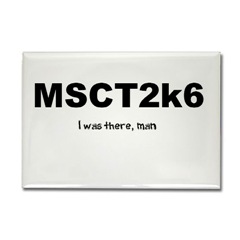
    You may not know it, but the Microsoft Redmond campus has like 100 different buildings. Okay, maybe not exactly 100, but there are a bunch, and for every 3 or so buildings, there is a different Microsoft cafeteria. Some buddies and I decided we'd try to visit each and every one, in Redmond at least, and document the journey. Everyone's always talking about Google's swanky eats, so consider this your Microsoft guided tour of our swanky eats. ;-) You'll notice us following in great MS tradition by naming our project something as approachable and easy to remember and understand as "MSCT2k6". Of course, we couldn't do this without some kind of memorabilia, so you guessed it, shirts, mugs, bags and yes, the MSCT Rectangle Magnet. As our tour leader says, "Consume! It'll make you feel better, honest."

    23 August 2006

    My Dream App

    So a new website has launched that intends to use the "wisdom of crowds" to identify the best ideas for a new "dream" Mac application. The registered users get to vote on all the ideas to narrow down the field, then judges will decided on 3 winning ideas. The net result will be 3 new Mac applications that will prove the, ahem, wisdom (or lack thereof) of those participating. I think it will flop. I hope it's wildly successful.

    Great ideas are NOT the limiting factor in software development! It's so much more about execution! Further, the driving forces behind great execution are much more multifaceted than a simple paper specification about how some application should behave. My favorite part of this process is:

    Customer: Please build X.
    Developer: Okay.
    (Time passes)
    Developer: Here is X!
    Customer: I know what I want, and X isn't it.

    It's everything that happens after this conversation that's important, not before. I liked what Daniel Jalkut says:

    This contest will do nothing except put a heavy burden on a small development team to turn somebody else’s ideas into the type of application that can usually only be inspired by the developer’s own dreams. Even when a team pursues a dream - their dream - success is far from assured.

    09 August 2006

    Moving on to AppleScript

    I've been super busy here at WWDC 2006, but it's that good kind of busy. Lots of new technology to learn and understand. It's been great! I did take some time yesterday to review some of the feedback online about our announcement to ship the next version of Mac Office without support for VB. This was a tough decision and one of those wicked problems that happen from time to time in software development. I think Erik's explanation of the challenges involved is one of his best posts yet. If you care at all that we are removing VB from Mac Office, read his post before you pass judgement. There's a lot of context to be had in there. Saying goodbye to Visual Basic Rich Schaut follows on with a post about what money can't buy and the challenges of software development in general. He then makes this comment:

    But that does not mean we are unaware of the pain this will cause to a significant number of users. If you think we are not aware of that pain, consider this. David Weiss can give you a better number on this, but our testing methodology has always made extensive use of scripts for automated tests. Not just a couple of scripts, but thousands of scripts per Office application. At one point, all of those scripts were written in VB/VBA. In order to carry that testing effort forward into the era of Universal Binaries, every single one of those scripts had to be rewritten in AppleScript. I don't think it's even a remote exaggeration to say that our use of VB/VBA was at least a couple orders of magnitude greater than even our most automated customers. Do we know your pain? You bet we do.
    This is absolutely true, we feel the pain. When we removed VB, immediately we lost more than half of our automated test bed. We've been carefully building back up our automation in ways that make sense, but it's a huge loss that those scripts no longer worked. That said, we know that AppleScript is capable and something we can depend upon long term not only for our testing efforts, but also for workflow customizations that our pro customers will use and build upon. Just last night I was at a WWDC party and I was introduced to a developer who had written a very cool script in VB to automate some of the work he and his team does on a regular basis. He was obviously concerned about what loosing VB would mean to him and his team with the next version of Mac Office. Everything he was doing with VB could be done in AppleScript and when we explained how AppleScript Studio provided a real IDE and UI workshop for developing custom solutions, he was very excited. If you have custom VB scripts, may I suggest looking into AppleScript as an alternative solution? There are great resources on building AppleScript automated workflows and it really is the Mac standard for inter-application communication. We are always looking for ways to make our AppleScript support better, so if in trying to make your VB solution work in AppleScript, you run up against a wall, let me know either in comments or via email. I think you'll be surprised at how much can be done with AppleScript today.

    01 August 2006

    Colour Like No Other

    I remember the first time I saw this Sony commercial, I was blown away. Check out the high quality QuickTime movie here. Simply amazing. This is the kind of creative advertising that inspires, entertains and sells. Well, it looks like they are at it again!

    What happens when you strap 70,000 liters of paint to the sides of some old buildings and explode the colored paint everywhere? I guess we'll find out.

    27 July 2006

    ExCodeWarrior Schwag

    I've written before about our ExCodeWarrior dev shirts we got as reward for successfully moving our code from CodeWarrior to Xcode. Well, now you too, can pay your respects to CodeWarrior, in mournful black, as well as honor the great work the Xcode team has done, and all this in time for WWDC 2006! I'll have my ExCodeWarrior shirt on, will you? ;-)

    03 July 2006

    The 2 Fingered Right-click

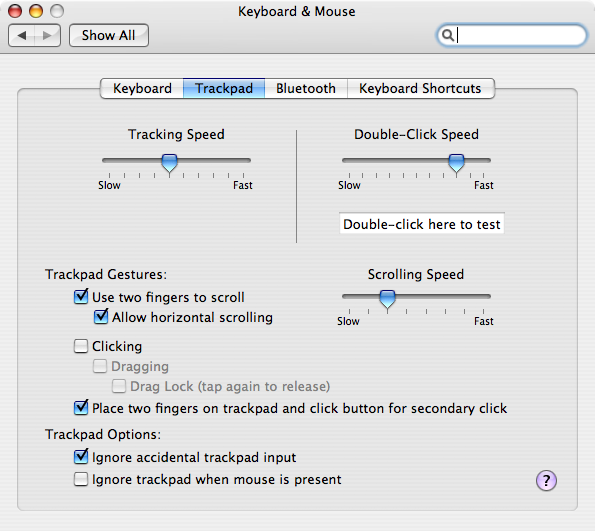
    For you die hard control-clickers MacBook Pro users out there, with Mac OS X 10.4.7, Apple just updated the OS so that in order to produce a right-click you simply place two fingers on the trackpad and click. While not as addicting as two fingered scrolling, this is a welcome improvement and allows Apple to retain their iconic single button mouse without a significant loss of functionality. Could a three fingered click be next? Don't count on it.

    28 June 2006

    WebKit's JavaScript debugger

    Now WebKit includes a JavaScript debugger named Drosera. To use it you need to get the newest build of Safari and enter this in the Terminal:

    defaults write com.apple.Safari WebKitScriptDebuggerEnabled -bool true

    The best quote is this one:

    One of the unique things about Drosera, like the Web Inspector, is that over 90% of it is written in HTML and JavaScript. This is a true testament of what you can do with web technologies today and the rapid development that WebKit allows.

    This is cool.

    23 June 2006

    Net Neutrality

    There is talk all over the internet and on capital hill about this "net neutrality" and what it is, and why it's important. I've heard several people try to define it, but Tim Berners-Lee, arguably the inventor of the Web, I think has said it best:

    Net neutrality is this:

    If I pay to connect to the Net with a certain quality of service, and you pay to connect with that or greater quality of service, then we can communicate at that level.

    That's all. Its up to the ISPs to make sure they interoperate so that that happens.

    Net Neutrality is NOT asking for the internet for free.

    Net Neutrality is NOT saying that one shouldn't pay more money for high quality of service. We always have, and we always will.

    When I pay my ISP for connecting to the Internet, I pay for the bandwidth for ALL traffic I choose to send an receive. If it is phone traffic (VOIP), web (HTTP) or video (RTSP), I want my bandwidth and quality of service to be the same across all protocols independent of the payload source or destination. The idea that my ISP (currently Verizon) could give priority to their VOIP services, their movie services and their web sites, while slowing or retarding the quality of other competing services seems repugnant to me and simply unfair. Net neutrality is important because it keeps the Internet a level playing field where competition can thrive.

    02 June 2006

    Adobe Obstructs PDF Growth

    According to CNet Adobe will file an antitrust suit against Microsoft. The reason? Adobe doesn't want the next version of Win Office to be able to save as PDF. Apparently they don't mind if Microsoft charges extra for the feature, but if it's included for free as part of the Office 2007 suite, that's not okay. Mac Office, and indeed every application on the Mac OS X that prints, can save to PDF. Can someone explain to me why Adobe would want to make it more difficult for Windows users to produce PDF documents? Print to PDF is one of my favorite features of Mac OS X. If Adobe goes after Microsoft why wouldn't they also go after Apple for including this kind of functionality in the Mac OS? This seems like a very strange move on Adobe's part.

    31 May 2005

    Customer Signature

    In July 2003 I was issued an American Express credit card. It just expired. I've used it for almost two years and I never signed the back! I have never, not even once, been asked to sign it! I guess I'm not alone! I wonder what the signature on the back of the card is supposed to mean anyway. If it is just to verify against the receipt I sign then it seems it is a sorely under-used security precaution. Once again, security is so very dependent on human process. If the process fails, so does the security.

    A good example of the human factor in security is this article. An estimated 500,000 people (perhaps as high as 1,000,000) had their account information stolen in "what may the biggest security breach to hit the banking industry." Who did this crime? "Account information on the customers was illegally sold by bank employees to a man identified as Orazio Lembo, whom police said was doing business by illegally posing as a collection agency." Brilliant.

    The Thing Legends Are Made Of

    Check out this fan made Nike commercial.

    Possibly the best golf shot of all time. Seriously, even if you don't play, you should watch this. It's 60 seconds long.